Hay, Pellets, and Forage: Understanding What Each Brings to the Rabbit’s Diet
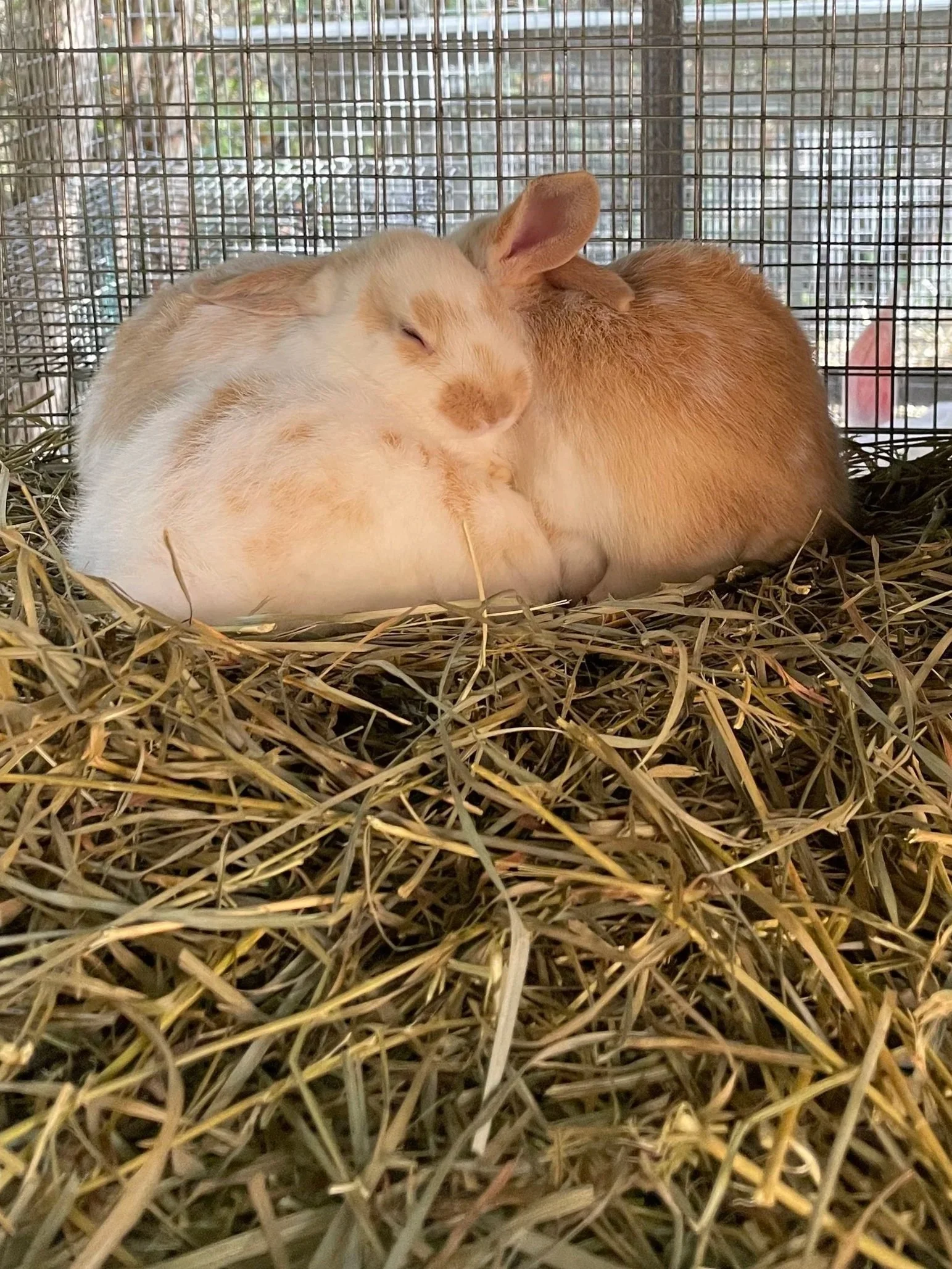
Three young rabbits sleep on a bed of hay.
When you first start raising rabbits, feeding them can seem surprisingly complicated.
One person tells you rabbits should eat mostly hay. Someone else raises an entire barn of healthy rabbits on pellets. Then you find people feeding weeds, branches, garden vegetables, and fresh greens and wonder whether that is what rabbits are actually supposed to eat.
The truth is that hay, pellets, and fresh forage aren't necessarily competing feeding systems.
They're different tools, and each has an important job to do.
Understanding those jobs makes it much easier to build a feeding program that works for the rabbits in front of you.
A Quick Look at Rabbit Digestion
Rabbits are hindgut fermenters. After food passes through the stomach and small intestine, fibrous material reaches a large pouch called the cecum, where microorganisms help break it down.
Rabbits also produce two different kinds of droppings.
The familiar dry, round pellets are waste. Cecotropes are soft, nutrient-rich material produced through fermentation in the cecum. Rabbits normally eat them directly as they're passed, allowing those nutrients to travel through the digestive system again.
You may never see your rabbit eating cecotropes, and that's perfectly normal.
This process, called cecotrophy, helps rabbits extract nutrition from fibrous plant material. Their digestive system is designed around eating plants and keeping material moving through the gastrointestinal tract, which is one reason fibre is so important.
Hay: Fibre and Chewing
Good-quality grass hay is one of the simplest ways to provide rabbits with plenty of long-stem fibre.
It encourages rabbits to spend time chewing and helps keep material moving through the digestive tract. That chewing also contributes to normal tooth wear — an important consideration for an animal whose teeth grow continuously.
Hay provides behavioural benefits too. Rabbits can pull it apart, sort through stems, and select what they want rather than finishing their meal in a few minutes.
For rabbits receiving a measured amount of concentrated feed, freely available grass hay can provide something fibrous to work through throughout the day.
Hay isn't nutritionally identical from bale to bale, however. Its value depends on the plants it contains, when they were harvested, and how the hay was stored. It's also bulky, requires dry storage, and can create a surprising amount of waste.
Hay's strength is long-stem fibre and extended chewing.
Pellets: Consistent Nutrition
A good commercial rabbit pellet is a formulated feed designed to provide protein, fibre, energy, vitamins, and minerals in relatively predictable amounts.
That consistency is incredibly useful.
It's particularly valuable for growing rabbits, breeding animals, and lactating does, whose nutritional demands can be considerably higher than those of a mature rabbit simply maintaining its weight.
Pellets are also easy to store, measure, and monitor. If a rabbit normally finishes a measured portion and suddenly leaves half of it behind, that change in appetite can be an early signal that something deserves attention.
The same concentration that makes pellets useful also means they should be fed with purpose. A rabbit can consume a lot of nutrition from pellets very quickly compared with the time required to work through hay or branches.
Pellets' strength is predictable, concentrated nutrition.
Fresh Forage: Variety and Enrichment
Fresh forage can include grasses, leafy greens, herbs, safe weeds, vegetables, leaves, twigs, and branches from rabbit-safe plants.
Its greatest strength may be variety.
Different plants provide different textures, flavours, nutrients, and ways of eating. Rabbits can strip bark from branches, tear leaves, select grasses, and investigate what they're offered. Fresh vegetation also contains plenty of moisture, contributing to water intake.
Forage can also turn plants already growing around a farm or garden into a useful resource rather than waste.
But this is where the rabbit keeper's knowledge becomes especially important.
Not every plant is safe. Roadside vegetation, treated lawns, and sprayed garden plants can introduce contaminants. Even safe foods should be introduced gradually when a rabbit isn't accustomed to eating them.
You don't need to identify every plant growing around you.
You need to confidently identify the plants you choose to feed.
Fresh forage can also be seasonal. Here in Canada, abundant summer vegetation eventually gives way to frozen ground and snow. Stored feeds like hay and pellets allow us to provide consistent nutrition when fresh plants aren't available.
Forage's strength is variety, moisture, enrichment, and making use of safe seasonal foods.
Different Rabbits Have Different Needs
There isn't one feeding program that makes sense for every rabbit.
A lactating doe feeding a large litter has very different nutritional demands from a mature buck maintaining his weight. A rapidly growing kit isn't the same as an adult pet rabbit carrying too much condition.
Season matters. Age matters. Reproductive status matters. Body condition matters.
This is where feeding becomes part of husbandry rather than simply filling a bowl.
We can look at the rabbit and ask:
Are they maintaining an appropriate body condition? Are they eating normally? Are their fecal pellets plentiful and normally formed? Are uneaten cecotropes appearing regularly? Has their appetite or water consumption changed?
The rabbit's response to the diet matters just as much as the diet itself.
Hay, Pellets, or Forage? Think About the Job
Instead of asking which feed is best, ask what you need the feed to accomplish.
Choose hay for fibre and chewing. Good-quality grass hay provides long-stem fibre, encourages extended chewing, and gives rabbits something to work through throughout the day.
Choose pellets for consistent nutrition. A quality commercial pellet makes it easier to provide predictable nutrition, particularly when feeding growing rabbits, breeding animals, and lactating does.
Choose fresh forage for variety and enrichment. Safe grasses, greens, leaves, vegetables, and branches add moisture, different textures, and opportunities for natural feeding behaviours.
In practice, these foods can complement rather than replace one another. The proportions may change depending on the rabbit, its stage of life, and the time of year, but each feed earns its place by doing something useful.
The Bottom Line
There doesn't need to be a winner in the hay-versus-pellets-versus-forage debate.
Hay provides fibre and chewing. Pellets provide concentrated, predictable nutrition. Forage provides variety, moisture, and enrichment.
The important part is understanding what each one contributes and choosing accordingly.
Watch the rabbit. Watch their appetite, droppings, body condition, and behaviour. Adjust the feeding program when their needs change.
Good feeding isn't about belonging to one feeding camp.
It's about knowing your options, understanding the animal, and using the right tool for the job.
